The Pants That Built America Were Never Meant for Cowboys
There is no piece of clothing more closely associated with American identity than the blue jean. Worn by presidents and teenagers, factory workers and rock stars, farmers and fashion designers, denim has traveled so far from its origins that most people who wear it have no idea where it actually came from — or why it was built the way it was.
Here's the part that tends to surprise people: blue jeans were not designed for the open range. They were not inspired by cowboys, cattle drives, or the romantic mythology of the American West. They were designed for men crawling through California dirt with their pockets full of rocks, and they were built because those pockets kept falling apart.
A Very Specific Problem
The California Gold Rush of 1849 drew hundreds of thousands of people west in search of fortune. Most of them didn't find gold. What they did find was brutal physical labor — sifting riverbeds, chipping at rock faces, hauling equipment through rough terrain. The work destroyed clothing at a remarkable rate.
Men working the mines needed pants that could handle the abuse. The standard trousers of the era were not up to the task. Seams split. Pockets tore away from the fabric. Workers would load their pockets with ore samples and hand tools, and the weight would simply pull the stitching apart.
This is the problem that eventually landed on the desk — or rather, in the correspondence — of a Latvian-born tailor named Jacob Davis, who was working in Reno, Nevada in the early 1870s.
The Tailor's Solution
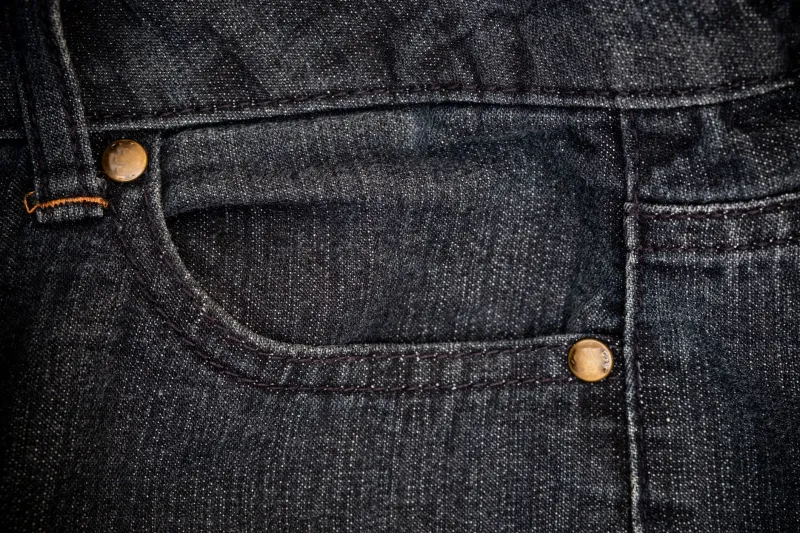
In 1870, a local woman came to Davis with a request: make a pair of pants tough enough for her husband, a laborer who kept destroying everything she bought him. Davis made the pants from a sturdy cotton fabric called denim and, in a moment of practical inspiration, added something new: copper rivets at the stress points — the corners of pockets, the base of the fly — the exact spots where fabric was most likely to fail under pressure.
The riveted pants held. Word spread. Other workers wanted them. Davis began producing more, and demand quickly outpaced what he could handle on his own.
Here's where Levi Strauss enters the story.
The Merchant Who Made It Official
Levi Strauss had come to San Francisco during the Gold Rush — not to mine, but to sell. He ran a dry goods business, supplying miners and merchants with fabric, clothing, and other necessities. Davis had been buying his denim from Strauss's company, which made him a natural partner when Davis needed help scaling up his riveted trouser business.
Davis wrote to Strauss in 1872, explaining the design and proposing that they file a patent together. Strauss agreed. On May 20, 1873, the United States Patent Office granted Patent No. 139,121 for "an Improvement in Fastening Pocket-Openings" — the copper-riveted denim trouser that would eventually become the most iconic garment in American history.
The date is now recognized as the official birthday of blue jeans. At the time, it was simply a practical solution to a working man's problem.
Who Actually Wore Them First
For the first several decades of their existence, jeans were workwear — and specifically, the workwear of miners, railroad laborers, and other men doing physically demanding jobs in the American West. They were not fashion items. They were not symbols. They were durable pants that didn't fall apart, priced for working-class budgets and built to take punishment.
Cowboys did eventually adopt them, but this happened gradually and somewhat incidentally. The garment's association with ranching culture grew over time simply because ranching was another form of hard outdoor labor in the same geographic region. The romantic cowboy mythology came later — much later — and it was largely constructed by forces that had nothing to do with the original pants.
Hollywood Did the Rest
The transformation of blue jeans from functional workwear into cultural symbol happened in the mid-twentieth century, and movies were the primary engine of that change.
Western films of the 1930s, 40s, and 50s dressed their heroes in denim, cementing the visual association between jeans and the frontier spirit. Then came actors like James Dean and Marlon Brando, who wore jeans not as workwear but as a statement — a deliberate rejection of the button-down conformity of postwar America. Suddenly, denim meant something beyond durability. It meant youth, rebellion, independence.
Levi Strauss & Co. was not slow to recognize this shift. The company leaned into the mythology, running campaigns that tied their product to the American West even as their actual customers were increasingly suburban teenagers who had never been near a mine or a cattle ranch.
By the 1960s and 70s, jeans had fully completed their journey from workwear to cultural uniform. They crossed oceans, showing up in Soviet black markets and Japanese vintage shops as symbols of American freedom. People who had never set foot in California or Nevada wore them as a kind of shorthand for something — individualism, maybe, or the idea of America as a place where you could build something from nothing.
The Rivets Are Still There
Here's the thing that ties all of this back to that original, unglamorous problem: if you pick up a pair of Levi's jeans today, the copper rivets are still there. Right at the pocket corners, exactly where Jacob Davis put them in 1873 to keep a Nevada laborer's pockets from tearing under the weight of tools.
The function has been largely ceremonial for generations — nobody is loading their pockets with ore samples anymore. But the rivets remain, a quiet piece of industrial problem-solving stitched into a garment that became a global icon.
The story of blue jeans is the story of how a purely practical object accumulates meaning over time — how something made to solve a specific, mundane problem gets picked up by culture, mythology, and marketing and turned into something much larger than its origins.
The miners who wore the first riveted trousers weren't making a statement. They just needed pants that lasted.
Everything else came later.