Frozen in Time: How a Surplus Turkey Problem Accidentally Stocked America's Freezers
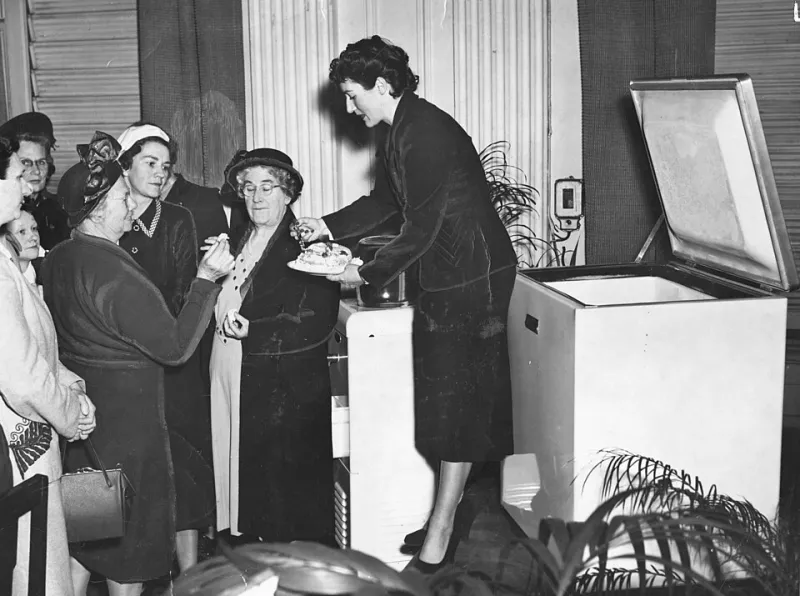
Photo: State Library of Queensland, Australia, No restrictions, via Wikimedia Commons
You've probably pulled a frozen dinner from the freezer without giving it a second thought. It's quick, it's easy, and it's been sitting in American homes since before your parents were born. But the story behind how it got there is stranger than anything printed on the box. It didn't come from a food scientist with a vision. It came from a warehouse full of leftover Thanksgiving turkeys and a company that desperately needed to get rid of them.
The Problem Nobody Saw Coming
After World War II ended, American food manufacturers were riding a wave of optimism. Soldiers were home. Families were reuniting. People were going to celebrate — and they were going to eat. Swanson, a Nebraska-based poultry company, made a very confident bet on how much turkey America wanted. For the 1953 holiday season, they prepared around 260 tons of frozen turkey.
Americans did not eat it all.
Swanson was left with a staggering surplus — some accounts put it at 520,000 pounds of cooked, frozen bird — sitting in refrigerated railroad cars that were being shuffled back and forth across the country just to keep the meat cold. The company was hemorrhaging money by the day. Something had to be done, and it had to be done fast.
A Swanson salesman named Gerry Thomas is often credited with the idea that followed — though the story has been contested over the years. The version that stuck goes like this: Thomas had seen airline meal trays during a flight, compartmentalized aluminum plates that kept different foods separate and warm. He sketched out a concept. Divide the turkey into portions. Add a side of cornbread dressing and sweet potatoes. Seal it in a sectioned aluminum tray. Sell it frozen.
The TV dinner was born not from innovation but from desperation.
Timing Is Everything
What made the idea actually work wasn't just the product — it was the moment. In 1953, television ownership in the United States was exploding. By the early 1950s, millions of American households had a TV set in the living room, and families were reorganizing their evenings around it. The formal sit-down dinner, with its china and its conversation, was quietly competing with the glow of a screen.
Swanson read the room. They called it a "TV Dinner" and packaged it in a box designed to look like a television set. The branding was deliberate. They weren't just selling food — they were selling permission. Permission to eat in front of the TV, to skip the elaborate cooking routine, to treat a weeknight meal as something you could assemble in minutes rather than hours.
The first TV dinners went on sale in 1954 for 98 cents each. Swanson sold ten million of them in the first year.
The Technology Behind the Tray
None of this would have been possible without a separate accidental discovery that had happened just a few years earlier. In 1945, a Raytheon engineer named Percy Spencer was working with radar equipment when he noticed that a chocolate bar in his pocket had melted near a magnetron — a device that generates microwave radiation. Spencer started experimenting deliberately, eventually developing the first microwave oven.
Early microwave ovens were enormous and expensive, used mainly in restaurants and industrial kitchens. But as the technology shrank and the price dropped through the 1960s and 1970s, it converged perfectly with the frozen food industry. By the time the home microwave became standard in American kitchens in the 1980s, the frozen dinner had been waiting patiently in the freezer for decades, ready for its upgrade.
The aluminum tray had to be replaced with microwave-safe materials. Cooking times were reformulated. Packaging changed. But the concept — a complete, portioned meal that required almost no effort — remained exactly what Gerry Thomas had sketched out on a napkin to solve a turkey problem.
What It Changed About the American Table
The frozen dinner did something that's easy to underestimate. It decoupled eating from cooking. Before it existed, eating a hot meal at home meant someone had cooked it. After it existed, that was no longer necessarily true. The labor of meal preparation — which had historically fallen to women — became optional, at least occasionally.
This had complicated social consequences. Some critics saw the TV dinner as a symbol of cultural laziness, a sign that American families were abandoning the dinner table for the couch. Others pointed out that it gave working mothers a legitimate shortcut, reducing the pressure of producing a full meal after a full workday.
What's clear is that it normalized convenience as a category. The TV dinner opened the door for frozen pizzas, microwavable burritos, steam-in-bag vegetables, and every other time-saving product that now fills the frozen food aisle. An entire section of the modern grocery store exists because Swanson misjudged how much turkey Americans would buy in 1953.
The First Bite You Never Knew You Were Taking
There's something almost poetic about it. The frozen dinner — one of the defining symbols of American convenience culture — wasn't engineered by forward-thinking food scientists. It was reverse-engineered from a logistical disaster. A company with too much turkey and too little time invented a new category of eating, and America never looked back.
Next time you peel back the plastic on a frozen meal and slide it into the microwave, you're participating in a tradition that started not with a chef's vision, but with a very cold, very expensive mistake sitting in a railroad car somewhere in the Midwest. Every familiar thing has a forgotten beginning — and this one started with leftovers.