A Candy Bar Melted in an Engineer's Pocket and Changed How America Eats Forever
A Candy Bar Melted in an Engineer's Pocket and Changed How America Eats Forever
Most kitchen appliances have a sensible origin story. Someone needed to keep food cold, so they built a refrigerator. Someone wanted toast without a fire, so they invented the electric toaster. The logic is clear, the need is obvious, the invention follows.
The microwave oven does not have that kind of story.
The microwave oven exists because a self-taught engineer with no formal education walked past a piece of military radar equipment and noticed that the candy bar in his pocket had turned into a warm, gooey mess. What happened next — over the following decades — quietly transformed the way Americans cook, snack, reheat leftovers, and think about time in the kitchen.
The Man and the Magnetron
Percy Spencer grew up in rural Maine at the turn of the twentieth century, orphaned young and largely self-educated. He taught himself electrical engineering by reading whatever he could get his hands on, eventually landing at Raytheon, a Massachusetts defense contractor that was doing serious work on radar technology during World War II.
Radar, in its simplest form, works by sending out radio waves and reading what bounces back. The component at the heart of this process is called a magnetron — a vacuum tube that generates microwave radiation. Spencer became one of the leading experts in magnetron production in the country, helping Raytheon dramatically increase the output of these devices for military use.
In 1945, Spencer was running tests on an active magnetron when he reached into his pocket and found that the chocolate bar he'd been carrying had melted. Not from body heat — it had softened in a way that felt different, faster, more thorough.
A less curious person might have shrugged and moved on. Spencer immediately started asking questions.
Popcorn First, Then an Egg
Spencer's first deliberate experiment with the magnetron involved a bag of popcorn kernels, which he held near the device. The kernels popped. He moved on to an egg, which he placed in front of the magnetron alongside a colleague. The egg exploded. The colleague reportedly got egg on his face — literally.
These were not controlled laboratory experiments. They were the actions of a deeply curious man following his instincts, which is how a significant number of genuinely important discoveries get made.
Within months, Raytheon had filed a patent for a microwave cooking device. By 1947, they had produced the first commercial microwave oven, which they called the Radarange — a name that made its military radar origins completely transparent.
The Radarange was not something you'd recognize today.
Six Feet Tall and the Price of a Car
The original commercial microwave stood roughly six feet tall, weighed around 750 pounds, required water cooling to operate, and cost somewhere between $2,000 and $3,000 — the equivalent of well over $25,000 today. It was installed primarily in restaurants, ships, and institutional kitchens where speed mattered more than counter space.
For ordinary American households, this machine was completely irrelevant. It was a commercial curiosity, a marvel of postwar engineering that most people would never see in person, let alone own.
The journey from that enormous, water-cooled industrial unit to the compact countertop appliance that now lives in roughly 90 percent of American homes took about three decades and involved contributions from multiple companies, engineers, and a significant amount of consumer skepticism.
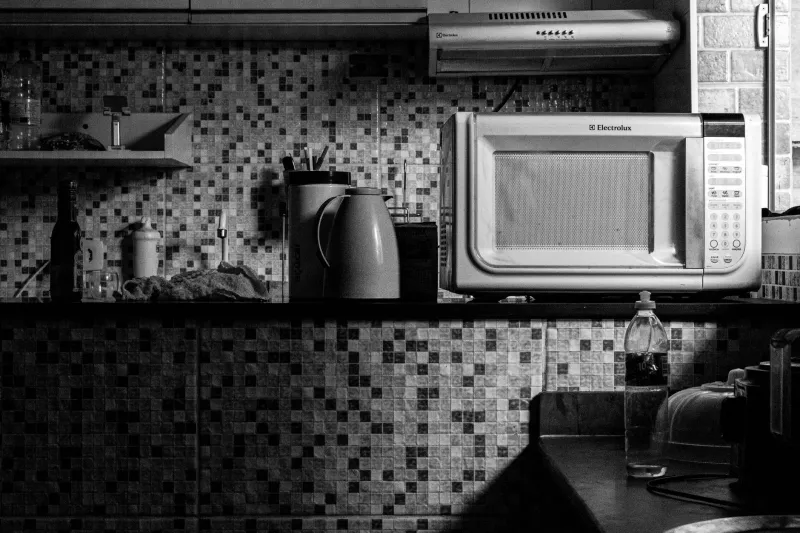
By the mid-1950s, Raytheon had licensed its technology to Tappan, which produced the first microwave marketed for home use in 1955. It was still large, still expensive, and still not something most families could afford or accommodate. The real turning point came in 1967, when Amana — by then a Raytheon subsidiary — released the countertop Radarange at around $500. Still pricey, but finally in the realm of possibility for middle-class households.
America's Most Skeptical Appliance
Even as prices dropped through the 1970s, Americans were not immediately enthusiastic. There was genuine public anxiety about microwave radiation — confusion between the non-ionizing microwave energy used in cooking and the ionizing radiation associated with nuclear weapons and X-rays. These are fundamentally different things, but the word "radiation" carried enough cultural weight in Cold War America to make people nervous.
Consumer Reports ran tests. Manufacturers added safety features and reassurances. Gradually, the practical benefits — reheating leftovers in minutes, defrosting frozen food, making popcorn without a pot — won out over the anxiety.
By 1975, microwave ovens were outselling conventional gas ranges in the United States. By the mid-1980s, they had become a standard fixture in American kitchens, and the phrase "just microwave it" had entered the everyday vocabulary.
What Percy Spencer Actually Built
Spencer received a patent for his microwave cooking discovery and was later awarded the Distinguished Public Service Award — the highest honor Raytheon could give. He never became wealthy from the invention in the way that some lone-garage inventors do, but he remained with Raytheon until his death in 1970, long enough to see the technology begin its slow march into American homes.
What's remarkable about the microwave story isn't just the accidental nature of the discovery — it's the sheer distance between the original context and the final application. The magnetron was built to detect enemy aircraft. It ended up reheating Tuesday's pasta.
That's the kind of leap that only happens when someone, instead of brushing chocolate off their fingers and getting back to work, stops and asks: wait — what just happened here?
Spencer asked. And American kitchens have never quite been the same.