Why Does Watermelon Taste Better With Salt? The Aristocratic Kitchen Trick That Became a Summer Secret
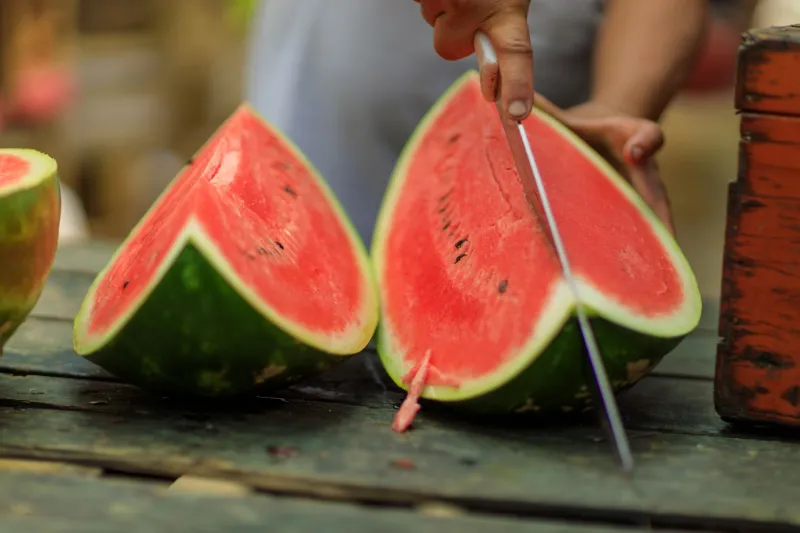
There's a specific kind of knowledge that gets passed down without explanation. You do it because your mother did it, and she did it because her mother did it, and at some point the original reason got lost somewhere between the generations. Salt on watermelon is exactly that kind of thing.
It seems wrong. Salt is savory. Watermelon is sweet. The combination sounds like a dare. But take one bite of a watermelon slice that's had a light pinch of salt scattered across it, and something clicks. It tastes more like watermelon than watermelon does without it. It's sweeter, more vivid, more itself.
That effect isn't a coincidence. It's chemistry. And it's been understood — and used deliberately — for a very long time.
The Banquet Table Problem
In 16th-century Europe, serving fruit at a feast was a statement of wealth. Melons, including early varieties of watermelon that had arrived via trade routes from Africa and the Middle East, were expensive, perishable, and temperamental. Getting one to the table at peak ripeness, particularly during a long multi-course banquet, was a genuine challenge.
Aristocratic kitchens of the period employed professional cooks who understood that fruit varied wildly in quality. An underripe melon was bland. An overripe one could taste fermented or flat. And because these feasts could stretch across hours, fruit served early in the evening might be noticeably different from the same fruit served later as it continued to change.
Salt was the solution. European cooks had long understood — through practice rather than formal science — that salt applied to fruit changed the way it tasted. It suppressed bitterness, masked off-notes, and made sweetness more pronounced. A mediocre melon could be made to taste considerably better. An already-good one could be made to taste exceptional.
This wasn't a casual garnish. It was a deliberate technique, documented in period cookbooks and household manuals. Salt on fruit was a mark of skilled preparation.
The Science Nobody Explained
It took centuries for anyone to formally explain what those Renaissance cooks already knew.
The mechanism comes down to how salt interacts with taste receptors. Sodium suppresses bitterness — it actually blocks the receptors responsible for detecting bitter compounds — which allows other flavors, particularly sweetness, to come forward more clearly. Watermelon contains trace bitter compounds alongside its sugars. A small amount of salt neutralizes those background notes, and the result is that the sweetness you're already tasting gets amplified because nothing is competing with it.
There's also a secondary effect involving osmosis. Salt draws moisture to the surface of the fruit, which concentrates the flavors already present in the flesh. You're essentially making the watermelon more intensely itself.
None of this requires a chemistry degree to experience. You just need to try it once.
How It Moved From Palace to Porch
The journey from aristocratic banquet hall to American backyard is a long one, and it didn't follow a straight line.
As watermelon spread through the Americas — it was being cultivated in the American South by the early 1600s, brought by enslaved Africans who had deep cultural familiarity with the fruit — it became increasingly common, eventually transitioning from luxury item to everyday summer staple. By the 19th century, watermelon was widely available and affordable across the South and much of the Midwest.
The salt habit traveled with it, passed through cooking traditions that had absorbed European techniques over generations, adapted by African American cooks who brought their own culinary knowledge to the practice, and eventually spread into the broader American summer food culture that crystallized around the late 19th and early 20th centuries.
By the time the American picnic became a cultural institution — those long Fourth of July afternoons, the church potluck, the family reunion — salted watermelon was already there. Not as a curiosity. As a given.
The Industrial Interruption
Here's where it gets interesting: the 20th century almost killed the habit.
As industrial food production standardized American eating, watermelons were selectively bred for sweetness, uniformity, and shelf stability. The irregular, sometimes-bland, sometimes-overripe melons that made salt a practical necessity gave way to consistently sweet, seedless varieties engineered to taste good without any intervention.
You'd expect that to end the tradition. If the melon is already sweet, why bother?
But the habit persisted. Partly because food traditions are stubborn. Partly because grandmothers kept doing it and nobody questioned them. And partly because — even with a perfectly sweet modern watermelon — the salt still works. The chemistry doesn't care whether the melon needs help. It just makes whatever's there taste more vivid.
A Trick Worth Keeping
What's remarkable about salt on watermelon is that it survived entirely on the strength of the experience itself. There was no marketing campaign, no cookbook revival, no food media moment that kept it alive. It persisted because every person who tried it noticed that it worked, and then they told someone else, or more often just kept doing it quietly for the rest of their lives.
The aristocrats who used it to rescue mediocre melons at their feasts would probably find it funny that their kitchen technique ended up on paper plates at summer barbecues in Kansas. But they'd understand why it stayed.
Some things survive because they're true. Salt on watermelon is one of them.