Two Cents and a Chicken Coop: The Obsessive Experiment That Put Ramen in Every American Dorm Room
Photo: Jang ikjun, CC BY-SA 4.0, via Wikimedia Commons
If you've ever been broke, in a hurry, or both, you've probably made instant ramen. You've probably made it more than once. You may have made it so many times that the sight of that foil flavor packet has become a kind of Pavlovian trigger. In American college dorms, it functions practically as a monetary unit. In some prison systems, it literally does.
And yet almost nobody who has eaten it — which is most people — knows where it actually came from. The origin story of instant ramen is one of the most unlikely product-launch stories in food history: a single man, a backyard shed, a near-total lack of institutional support, and two years of daily failure that somehow produced one of the best-selling packaged foods ever made.
The Man in the Cold
The year was 1945, and Japan had just lost a war. Entire cities had been flattened. Supply chains were destroyed. Food was desperately scarce, and the black market was one of the few places you could reliably find anything to eat.
Momofuku Ando was a Taiwanese-Japanese businessman in his thirties who had already cycled through several failed ventures. Standing in the ruins of Osaka one winter evening, he watched a long line of people waiting in the cold outside a makeshift ramen stall, shuffling forward for a bowl of hot noodle soup. The image stayed with him.
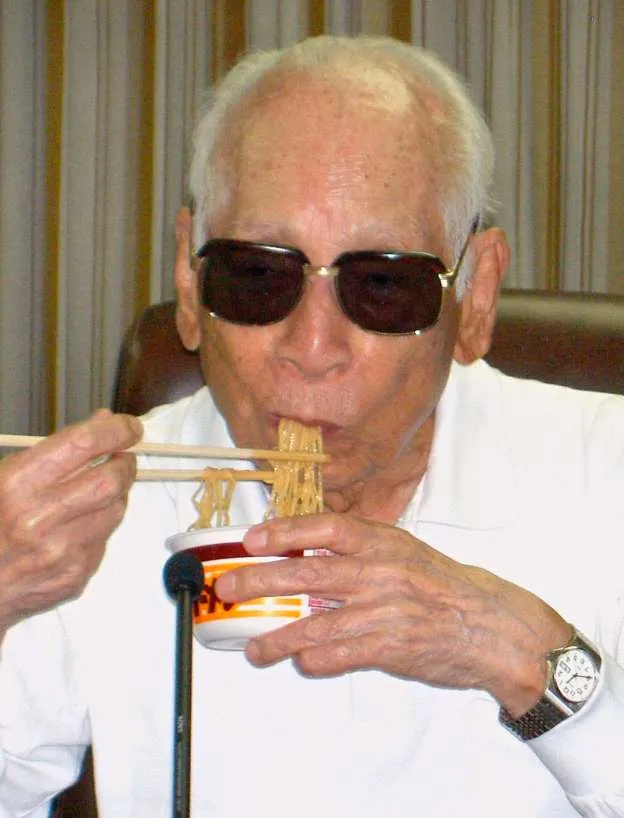 Photo: Momofuku Ando, via www.pacificatrocities.org
Ando wasn't a trained chef or a food scientist. He was a businessman with a restless mind and a specific obsession: he believed that if you could make a noodle that was already cooked and dried — one that could be prepared with nothing but hot water — you could feed people cheaply, quickly, and anywhere. He spent the next decade trying to figure out how to do it.
The Shed Where It Happened
By 1957, Ando had lost his textile company, defaulted on debts, and spent time in prison on tax charges. He was, by most conventional measures, not a promising candidate to revolutionize global food. What he did have was a small wooden shed behind his house in Ikeda, a suburb of Osaka, and an absolute refusal to stop experimenting.
He worked in that shed every day for two years. The central problem was preservation: how do you cook a noodle, keep it shelf-stable for months, and still have it reconstitute properly when a customer pours boiling water over it? Every approach he tried either produced noodles that went rancid, turned to mush, or came out tasting like cardboard.
The breakthrough came, as so many food breakthroughs do, from watching something completely unrelated. His wife was frying tempura in the kitchen, and Ando noticed how the hot oil rapidly evaporated moisture from the batter, leaving behind a light, porous structure. He tried applying the same principle to noodles — flash-frying them in oil after they'd been seasoned — and it worked. The oil bath dried the noodles almost instantly, locking in flavor and leaving thousands of tiny holes that would reabsorb hot water in minutes.
Chicken Ramen, the world's first instant noodle product, launched in Japan in 1958. It cost five times more than fresh ramen. The food industry told him it would never sell.
Cold War Noodles
Ando's product became a hit in Japan relatively quickly, but its journey to America was less about culinary enthusiasm and more about geopolitics.
In the 1950s and 60s, the United States was shipping enormous quantities of wheat flour to Japan as part of postwar aid and Cold War food diplomacy. American policy actively encouraged the Japanese government to promote wheat-based foods — bread, noodles, pasta — as part of a strategy to create a long-term export market for American agricultural surplus. The Japanese government, in turn, pushed these foods through school lunch programs and public messaging.
Ando's noodles were perfectly positioned to benefit. They were wheat-based, shelf-stable, and cheap to produce at scale. His company, Nissin Foods, grew rapidly through the 1960s.
The American version of the product arrived in 1970 when Nissin began exporting to the U.S. market. It sold reasonably well, but the real turning point came in 1971 when Ando invented Cup Noodles — the same flash-fried noodle block, but packaged directly inside a foam cup that served as the cooking vessel. You added hot water, waited three minutes, and ate out of the container. No bowl required. No utensils necessary beyond a fork or chopsticks.
American consumers, who had already been trained by fast food culture to expect speed and convenience, embraced it immediately.
The Currency Nobody Planned
By the 1980s, instant ramen had become a fixture of American student life, not because any marketing campaign targeted college students specifically, but because the price point made it the cheapest hot meal most people had ever seen. At its lowest, a single package cost less than a quarter.
The sociological role it plays in American culture today — as survival food, as comfort food, as the punchline to every broke-college-student joke — was entirely unplanned. Ando was trying to solve postwar hunger in Japan. He had no particular vision for the American dorm room or the prison commissary.
But that's how the best accidental discoveries work. You solve one problem, and the solution quietly migrates into contexts you never imagined, filling needs nobody had articulated yet. The man in the chicken-coop shed in Osaka couldn't have pictured it. He was just trying to get the noodles right.