The Woman Tupperware Tried to Erase Built the Business That Made Plastic Containers a Household Name
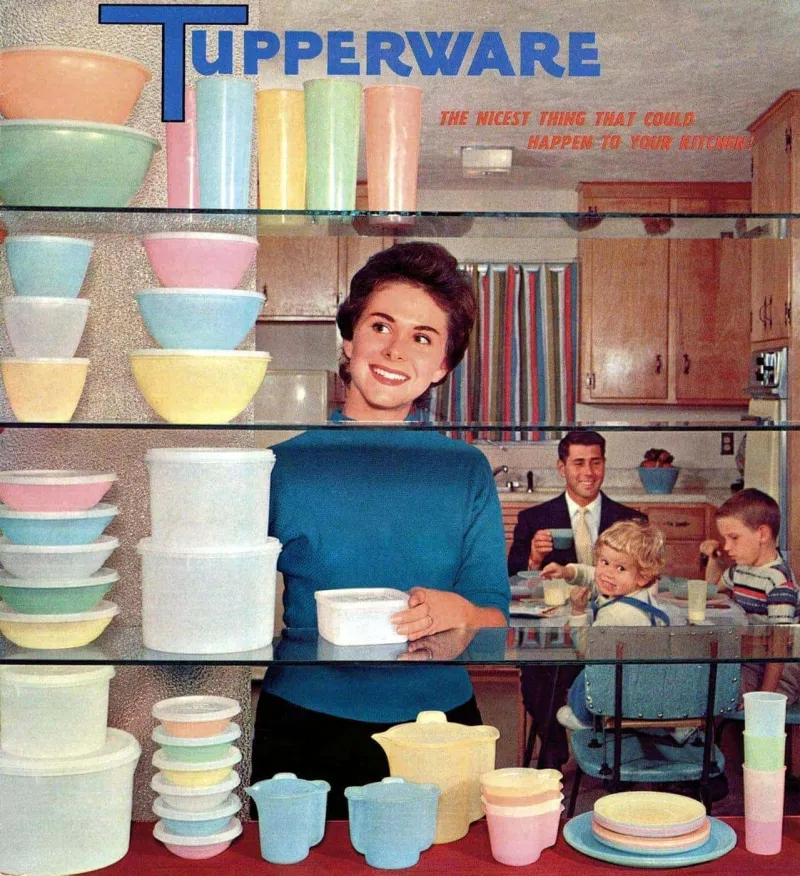
Photo: vintage 1950s Tupperware colorful plastic containers kitchen, via clickamericana.com
If you've ever sealed a leftover bowl of chili with a satisfying snap, stacked mismatched containers in a kitchen cabinet, or inherited a piece of avocado-green plastic from your grandmother, you've felt the legacy of Tupperware. It's one of those products so thoroughly woven into domestic American life that it barely registers as a brand anymore — it's just a thing kitchens have.
But Tupperware almost didn't make it. For years, the product that would eventually become a cultural institution was a commercial failure. And the person who rescued it — a resourceful, charismatic woman named Brownie Wise — was eventually written out of the company's official story almost entirely.
The Plastic That Nobody Wanted
Earl Tupper invented his signature food storage containers in 1946, using a flexible polyethylene plastic he'd developed from a DuPont byproduct. The design was genuinely innovative — the airtight seal, created by pressing the lid down and releasing a small burp of air, was unlike anything else on the market. Tupper was proud of the engineering.
The problem was that nobody could figure out how to buy it. Tupperware hit department stores and hardware stores in the late 1940s and moved slowly, if at all. The seal — the product's defining feature — wasn't intuitive from a shelf display. Customers would pick up a container, press the lid on incorrectly, decide it didn't work, and put it back down. Without a demonstration, the product's main selling point was invisible.
Tupper's company was stagnating. Sales were flat. The containers were piling up in warehouses.
Enter Brownie Wise
Brownie Wise was not an obvious candidate to save a plastics company. She was a divorced single mother living in Florida with a teenage son, working a sales job and making ends meet. She had no formal business training, no corporate connections, and no particular reason to care about polyethylene food storage.
What she had was an instinct for people.
Wise had been selling Tupperware through home demonstrations in the early 1950s — not because the company asked her to, but because she'd figured out on her own that the product made sense in a living room, not a store aisle. She'd gather a group of women at someone's house, show them how the seal worked, let them handle the containers, and take orders on the spot. Her sales numbers were extraordinary.
Tupper noticed. In 1951, he hired Wise as vice president of Tupperware Home Parties, a new division built entirely around her model. He pulled the product from retail stores completely — a decision that seemed bizarre at the time — and put everything behind direct home sales.
The Party as a Sales Machine
What Wise had understood, and what Tupper's retail strategy had missed entirely, was that Tupperware's real competition wasn't other food storage products. It was housewife isolation.
In postwar suburban America, millions of women were living in new developments far from family and old friends, managing households without much outside stimulation. The Tupperware party gave them a reason to gather, a social structure, and — crucially — a low-pressure way to earn their own money without challenging the domestic expectations of the era. Wise framed the sales opportunity in terms of community and independence, not just commission.
Hostesses earned free products for opening their homes. Saleswomen built their own downlines and kept a percentage of their recruits' sales. The whole system was self-replicating — every party generated new hostesses, new saleswomen, new parties. It was a social network operating decades before that phrase meant anything.
By the mid-1950s, Tupperware was a genuine phenomenon. Wise appeared on the cover of Business Week in 1954 — the first woman to do so. She was running sales rallies that felt more like revival meetings than corporate events, complete with motivational speeches, prizes, and collective enthusiasm. She understood that she wasn't just selling containers. She was selling belonging.
The Erasure
In 1958, Earl Tupper fired Brownie Wise. The official explanations were vague — personality conflicts, disagreements over direction. She received no stock, minimal severance, and was contractually barred from discussing the company. Tupper sold the business to Rexall Drug Company shortly afterward for $16 million and moved to a private island.
For decades, Wise's role in building Tupperware was minimized or omitted from the brand's history. The product's success was attributed to the design, the material, the concept — not to the specific genius of the woman who figured out how to actually sell it.
Historians and journalists have spent the years since working to correct that record. Wise's story was the subject of a 2011 documentary, and her rehabilitation as a business pioneer has been largely complete for some time now. But the erasure itself is worth noting — partly because it says something about how female contributions to American business history have been treated, and partly because it's genuinely strange to acknowledge a product's cultural dominance while ignoring the person most responsible for creating it.
What She Left Behind
The direct-sales party model Wise invented — or at least perfected — didn't die with her exit from Tupperware. It became the template for an entire category of American commerce. Avon, Mary Kay, Pampered Chef, LuLaRoe, and dozens of others have used variations of the same structure: social networks, home demonstrations, hostess incentives, commission-based salesforces made up largely of women.
Tupperware itself filed for bankruptcy in 2024, a casualty of changing retail habits and a brand that had perhaps been too successful for too long — so synonymous with food storage that it became a generic word rather than a competitive product.
But the containers are still in your cabinet. The snap-seal lid still works the same way it did in 1946. And somewhere in the DNA of every direct-sales pitch you've ever received is the echo of a Florida saleswoman who figured out that the best place to sell something isn't a shelf — it's a room full of friends.