The Factory Worker's Burned Fingers That Changed Every American Breakfast
The Sound That Wakes America
Every morning, millions of Americans hear the same metallic pop echoing from their kitchens—the distinctive sound of bread slices launching skyward from their toasters. It's become so embedded in our breakfast routine that we barely notice it anymore. But this familiar sound exists because of one factory worker's frustration with burned fingertips.
When Breakfast Was a Dangerous Job
In 1919, Charles Strite worked at a factory cafeteria in Stillwater, Minnesota. His job involved operating primitive bread-warming machines that heated slices over open coils. The problem? These early devices had no automatic shutoff. Workers had to manually flip and remove the bread, often burning their fingers in the process.
 Photo: Stillwater, Minnesota, via cdn-assets.alltrails.com
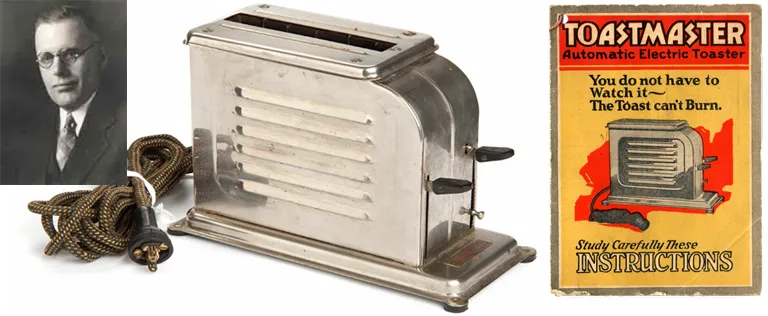 Photo: Charles Strite, via www.khtheat.com
Strite watched his coworkers struggle with the same painful routine day after day. "There has to be a better way," he thought, nursing yet another set of singed fingertips. He wasn't dreaming of transforming American breakfast culture—he just wanted to make toast without injury.
The Mechanic's Solution
With a background in mechanics, Strite began tinkering in his spare time. His breakthrough came when he designed a spring-loaded mechanism that would automatically eject bread slices when they reached the proper temperature. A simple bimetallic strip would bend from the heat, triggering the release.
On May 29, 1921, Strite received Patent No. 1,394,450 for his "Automatic Pop-Up Toaster." The device featured heating elements on both sides of the bread and that crucial spring mechanism that would literally launch perfectly toasted slices into the air.
When Bakeries Said No
Strite initially marketed his invention to commercial bakeries and restaurants, figuring they'd appreciate the efficiency and safety improvements. He was wrong. Bakeries already had established systems for warming bread, and restaurant owners worried about the cost and complexity of the new machines.
For several years, Strite's revolutionary toaster gathered dust. The food service industry simply wasn't ready for automatic bread ejection.
The Home Revolution Nobody Expected
Everything changed when the Waters Genter Company purchased Strite's patent in 1925. Instead of targeting commercial kitchens, they saw potential in American homes. They rebranded the device as the "Toastmaster" and began marketing it to housewives as a labor-saving kitchen marvel.
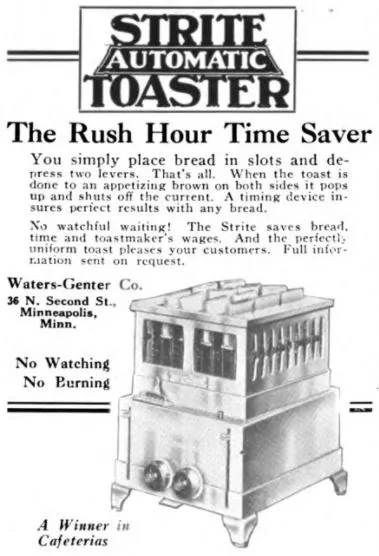 Photo: Waters Genter Company, via static.wikia.nocookie.net
The timing was perfect. American households were increasingly connected to electrical grids, and the post-World War I economy had created a growing middle class hungry for modern conveniences. The pop-up toaster promised perfectly golden bread with minimal effort—no more standing over a hot stove or dealing with unevenly heated slices.
Creating the Perfect Slice
What made Strite's design revolutionary wasn't just the pop-up mechanism—it was the consistent results. His toaster heated both sides of the bread simultaneously and stopped automatically when the optimal color was achieved. This created the standardized "golden brown" that became America's breakfast ideal.
Before the pop-up toaster, bread preparation varied wildly from household to household. Some families preferred barely warmed bread, others liked it nearly charred. Strite's invention essentially democratized the perfect slice, creating a national standard for what breakfast bread should look like.
The Sound of Success
By the 1930s, that distinctive pop had become the unofficial soundtrack of American mornings. The sound was so satisfying and reliable that manufacturers began designing toasters specifically to enhance it. The metallic ping wasn't just functional—it was psychological reassurance that breakfast was ready.
The pop-up mechanism also solved a uniquely American problem: impatience. Unlike European breakfast traditions that involved leisurely bread preparation, Americans increasingly valued speed and efficiency in their morning routines. The automatic ejection meant no waiting, no watching, no thinking—just perfectly timed toast.
From Factory Floor to Kitchen Counter
What started as a workplace safety solution had accidentally created one of America's most enduring breakfast rituals. Strite's spring-loaded mechanism didn't just prevent burned fingers—it established the rhythm of the American morning.
Today, nearly a century later, that same basic pop-up principle operates in millions of toasters across the country. Every time you hear that familiar metallic sound, you're experiencing the echo of Charles Strite's burned fingertips and his simple desire to make toast without pain.
The factory worker who just wanted to avoid injury had inadvertently given America the sound of breakfast itself.