The Checkout Counter Snack With a 10,000-Year Head Start on Everything Else in the Store
The Checkout Counter Snack With a 10,000-Year Head Start on Everything Else in the Store
You've grabbed one without thinking about it a hundred times. It's hanging in a wire rack near the register, sealed in a glossy bag, usually priced somewhere between a dollar fifty and four dollars depending on how upscale the truck stop is. Beef jerky is such a fixture of American gas stations and convenience stores that it barely registers as a choice — it's just there, the way chapstick and phone chargers are just there.
What doesn't show up on the packaging is the backstory: that the dried, preserved meat in your hand represents one of the oldest food preservation technologies on the continent, developed by Indigenous peoples thousands of years before the first convenience store existed, refined across centuries of survival and trade, and quietly transformed into a checkout impulse buy somewhere around the Reagan administration.
The journey is a long one. It's worth taking.
Where It Actually Begins
Long before European contact, Indigenous nations across North America had developed highly sophisticated methods for preserving protein for travel, trade, and winter survival. The specific technique varied by region and culture, but the underlying principle was consistent: remove the moisture from meat, combine it with fat, and you get something that won't spoil for months.
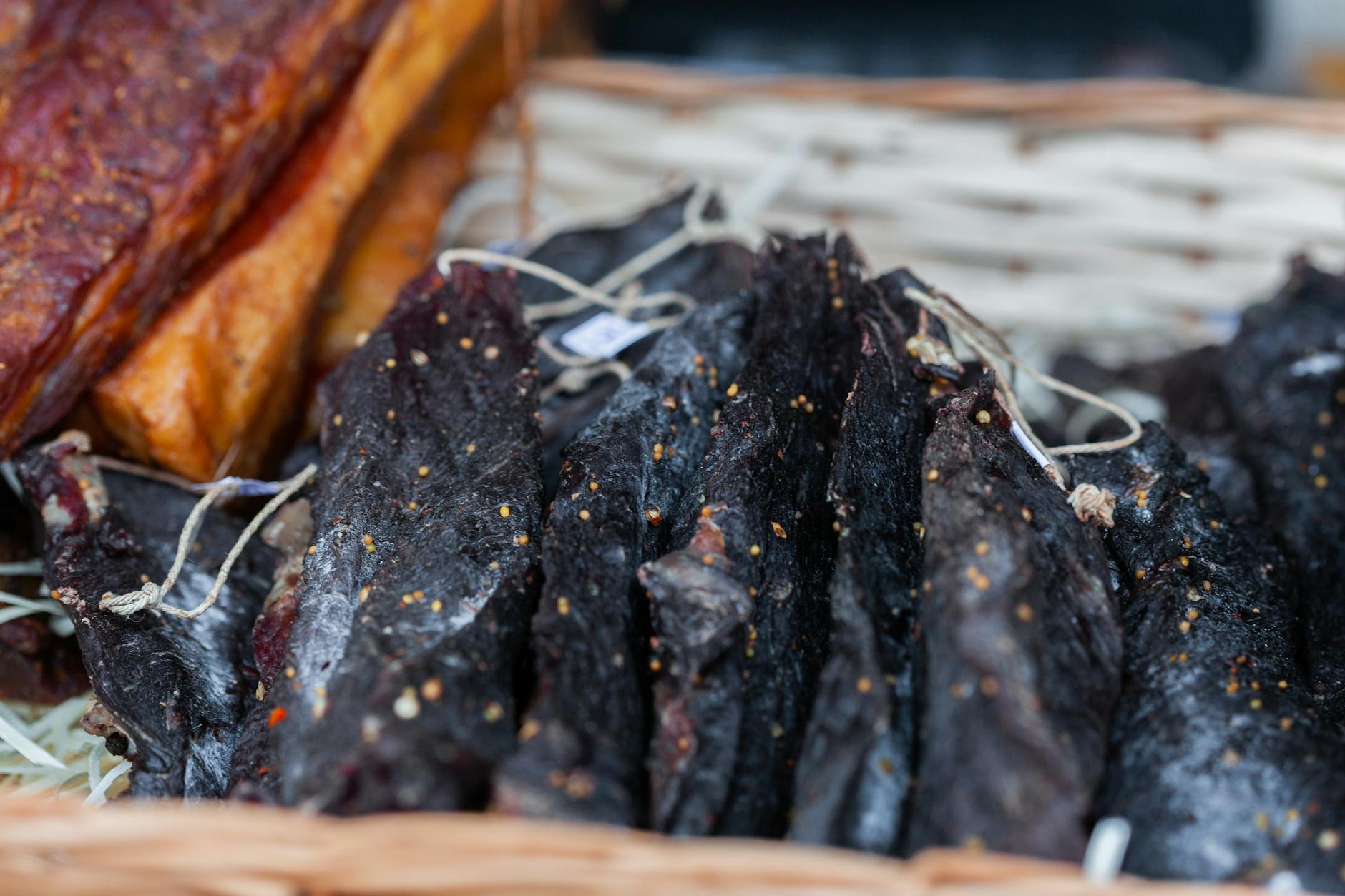
The most refined version of this technology was pemmican, developed primarily by Plains nations including the Cree, Métis, and various Lakota peoples. Pemmican was made by drying thin strips of bison, elk, or deer meat in the sun or over low heat, then pounding the dried meat into a coarse powder and mixing it with rendered fat — often tallow — and sometimes dried berries like saskatoon or chokecherry for additional calories and flavor.
The result was a dense, shelf-stable block of concentrated nutrition that could sustain a person through days of travel or hard physical labor. Calorie-dense, lightweight, and requiring no refrigeration, pemmican wasn't just a snack — it was an engineering solution to one of the most fundamental challenges of life on the move.
Trade networks carried it across vast distances. Pemmican made at one location might travel hundreds of miles before being consumed, exchanged alongside other goods at major trading gatherings.
The Fur Trade and the First Non-Indigenous Consumers
When European fur traders pushed into the interior of North America in the 17th and 18th centuries, they encountered pemmican through their relationships with Indigenous trading partners — and they immediately understood its value.
For the Hudson's Bay Company and the North West Company, operating across the enormous distances of the Canadian interior and the northern United States, pemmican became essential infrastructure. Voyageurs paddling canoes through remote waterways for weeks at a stretch needed food that traveled well and required no preparation. Pemmican fit perfectly. The fur trade created a commercial demand for it, and Indigenous producers supplied that demand at scale.
American explorers adopted it similarly. The Lewis and Clark Expedition carried preserved meat on their journey west, and accounts from the expedition reflect an understanding — learned partly from Indigenous guides — of how dried and preserved meat could sustain a party through territory where resupply was impossible.
Civil War Rations and the Spread Eastward
The Civil War brought preserved meat technology to a much wider American audience, though in a rougher form than traditional pemmican.
Union and Confederate soldiers alike relied on dried and salted beef as a field ration. The quality was often poor — soldiers had unflattering nicknames for their issued rations — but the principle was the same one Indigenous peoples had refined centuries earlier: take the water out of the meat, and it lasts. Army supply chains couldn't keep fresh food moving to troops in the field, and preserved beef filled the gap.
After the war, the cattle industry boomed across the Great Plains, and the practice of drying beef strips became more widespread among ranchers and cowboys who needed portable food for long drives. The technique absorbed regional influences and slowly began to standardize around a recognizable form: thin strips of beef, dried and seasoned, tough enough to chew slowly.
The word "jerky" itself traces back to the Spanish charqui, derived from the Quechua word ch'arki, meaning dried meat — a linguistic reminder that this preservation method was well established in South America long before it arrived in North American kitchens.
From Survival Food to Snack Aisle Staple
For much of the 20th century, jerky remained a regional and working-class food — something you made at home, bought from a small producer, or found at roadside stands in cattle country. It wasn't particularly glamorous, and it wasn't widely distributed.
The 1980s changed that in two directions at once.
First, the fitness and high-protein diet movement created a new frame for jerky: not as a rough trail food but as a lean, protein-dense snack that fit the era's obsession with macros and muscle. Second, large-scale food manufacturers — Jack Link's, Slim Jim, and others — invested in industrial production and national distribution, landing jerky in convenience stores, gas stations, and grocery checkout lanes from coast to coast.
Marketing leaned into the rugged, outdoorsy associations the food had accumulated over centuries. The guy on the packaging was always squinting into a mountain wind, never standing in a break room. The survival heritage was part of the brand, even if most bags were being opened in parking lots.
Today, the US beef jerky market is valued at over four billion dollars annually. Premium and artisanal producers have added a new layer — grass-fed, small-batch, exotic flavors — pushing the product further up the cultural ladder.
What's Actually in Your Hand
Here's the thing about jerky that the gas station display doesn't tell you: you're holding a direct descendant of one of the most successful food technologies ever developed on this continent. The hands that first worked out the relationship between dried meat, fat, and long-term preservation weren't working in a food lab. They were solving a real problem — how to carry enough nutrition across a landscape that didn't offer the luxury of stopping.
Every innovation that came after — the fur trade supply chains, the Civil War rations, the 1980s protein-snack rebrand — was built on that original insight.
The packaging has changed considerably. The idea behind it hasn't moved an inch.